

In Metro Exodus you play as series protagonist Artyom as he’s tasked with finding his wife, his father-in-law, and his crew a safe haven away from the hostile and heavily irradiated Moscow. Artyom always believed there was life outside the metro tunnels, and that the rest of Russia, if not, the world, survived the great war that forced people underground into Russia’s metro tunnels. But to most, life beyond Moscow was a ridiculous idea and nobody took the annoyingly silent Artyom seriously. But after events that I won’t spoil, the crew of the Aurora, a train operated by its main mechanic Yermak, find themselves in uncharted territory across three main areas. Here is where the third game in the Metro series goes in a different direction and shines.
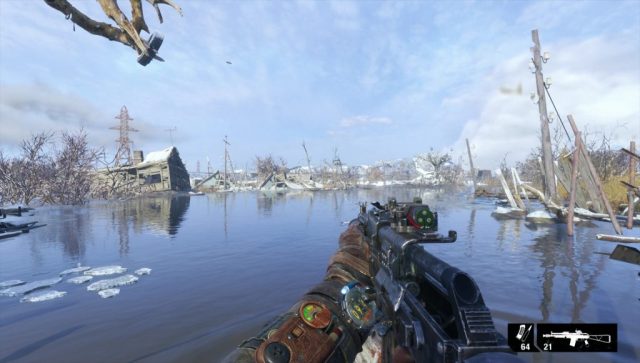
Metro is sectioned off into three sandbox-like areas: the flooded, swamp-like Volga, the dry and barren Caspian Sea, and the dense and dangerous forest in Taiga. These areas are all compact and relatively small compared to most open world maps and areas in games today, but they still managed to be open for exploration. What I loved the most about exploring each “level” was that they felt very distinct and each map had a few points of interest to incentivize the exploration. But I want to talk about the first open area, Volga, and how it sets up what the player can expect for the rest of the game with its exploration and showing how people in Russia survived. This is where I enjoyed Metro the most because of the potential rewards for exploring, the environmental stories, and the dangers you’d come across.
As mentioned before, Volga is the first semi-open area to explore. What I liked was that members of your crew would mention, in passing, areas on the map they’ve heard about that might be worth checking out. So I decided to take them up on this and set out to see what I could find in this swamp (Thankfully it wasn’t Shrek’s swamp). Navigating the area wasn’t easy though because mutated creatures lurk at night and can hunt in packs. Crabs with incredibly tough shells creep underwater and can disorient you; human-like ghouls chase you in packs and are unrelenting in their pursuit.
My favorite moment, but the saddest realization, in the game came when I stopped at a random house in the middle of Volga. Where most houses were destroyed with little more than some ammo or crafting materials inside, this one was still intact. Walking inside, there were skeletons littered throughout the house, including one that was hanged. Chairs, walkers and medical equipment are laying around too and you can assume this was a makeshift hospital or medical house for the people there. Upon reading a note in the house, you learn it’s a patient ledger and the person writing it is trying their best to take care of these heavily irradiated people.
As the ledger goes on, you learn that more people die throughout the month and the “caretaker” can’t do anything to help at this point. Eventually, they’re the only person to wake up one day and can’t live with the pain and suffering. And here is where I assumed that the writer was the same person who I found hanged. And as you walk around the house, you see the faint ghostly forms of the people in the house, crying and looking in pain. It was creepy, but more so it was heartbreaking and a sad realization that not everyone was as lucky to survive the bombings scot-free like Artyom. It’s moments like this that helped illustrate how fucked up the world is in Metro Exodus.
On top of that, bandits hold down camps and buildings and can easily overwhelm you if you’re not careful. If you mess up once while trying to sneak around, you could have five guys with guns searching around. And where it doesn’t take much to kill Artyom, this makes it even more stressful. You also have to get around most of the time using rowboats that are a pain to use, but when the world goes to shit, there aren’t many options left. But exploring felt rewarding because of the guns and equipment you’d come across to help on the journey. Infiltrating and successfully taking out a bandit camp was useful because of the gun modifications you’d find, and sometimes a piece of equipment so Artyom could carry more ammo or more easily see where enemies were.
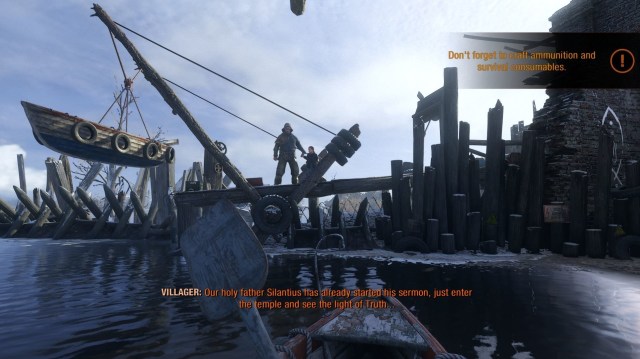
But wait there’s more! There’s a cult that believes technology is pure evil and worships a massive, heavily irradiated fish. They believe that the electrical anomalies that manifest from the radiation and environment are demons and that technology is to blame. Their leader Silantius brainwashes his people into believing this, and it’s sad to see what people will resort to when there’s little hope in Volga. I remember encountering a father and son at a safe house and hearing the father criticize this cult and his son for being part of it. One of the funniest things was when I turned on my flashlight and the dad had to explain to his perplexed son that this is what people had before the world was ruined.
Metro Exodus has some interesting stories to tell across its three environments. While Volga wasn’t aesthetically my favorite open area, I felt it best represented what the world outside Moscow was like. It set up the rest of the game really well and left me excited to explore the Caspian Sea and Taiga, and see how the people there survive and to see what weird creatures or events I would come across. Metro did a wonderful job transitioning to a more open game while still managing to tell interesting stories across its environments.
 Video Games | Craft Beer | Liquor